|
|
|
|
아래
내용은 linuxcertification.com의 내용입니다. (아직 한글화하여
정리하지 못했습니다.)
Why Certify?
What does this mean to you? It means that you now
have a vast new set of tools at your disposal, and employers will want
(expect) you to be responsible for the operating system (OS), GUI, and common
applications! Does this sound stressful? It shouldn't. In general Linux
administrators are extremely happy with their systems and the new-found
control they have over the software. It is not unusual for these administrators
to become devoted to Linux and to greatly prefer their Linux system to the
typical commercial OSs that are available.
What Sair Linux and GNU Certification Can Do For You:
- Today's employers want verification that computer professionals have
the specific set of skills that they need. Certificates tell employers that the
professional does indeed possess the necessary skills. Furthermore, companies
exploit the certification of the computer professionals they employ by
advertising their certification skills to the customer.
- Linux certification tends to provide the computer professional with
greater employment opportunities. For example, if one wanted to move from
programming into Internet attachment, firewall implementation, and system
security, a Linux certificate will not guarantee a new Internet job, but it will
go a long way toward helping one obtain the new position.
- Certificates tend to lead to higher wages. Studies have shown that
certification in a desired skill will increase earnings anywhere from $5 to $10
per hour (thus, yielding a $10,000 to $20,000 per year salary increase) over
non-certified computer professionals.
- Certificates provide a highly visible form of accomplishment. A Linux
certificate lets you hang out a sign, so to speak, that says "I am highly
skilled", "I have drive", "I like challenges".
- Certificates provide valuable benefits for corporate investment.
Research shows that past corporate investment creates a positive return in the
form of improved employee service, reduced problem solving time, easier
assimilation of new technology, and increased overall employee productivity.
Consequently, corporations are often happy to pay for or assist with
certification costs.
- Certificates can be viewed as a part of the philosophy that views
learning as a life-long process. We all learn everyday, but focusing on a goal
and earning a certificate validates the learning process and leads to improving
one's level of efficiency in the workplace. Moreover, certification ensures that
one will become familiar with new advances in technology.
- An increased rate of learning leads to increased job security. This
increased security arises from being more valuable to the company and to other
companies. All of this leads to peace of mind and a better quality of life for
you and your family.
- The Sair Linux and GNU code of ethics provides credibility to both
the employer and the employer's customers. It says that you are a professional
-- that you have been trained in ethics and that you pledge to be ethical in
your professional conduct.
|
|
Individual Benefits
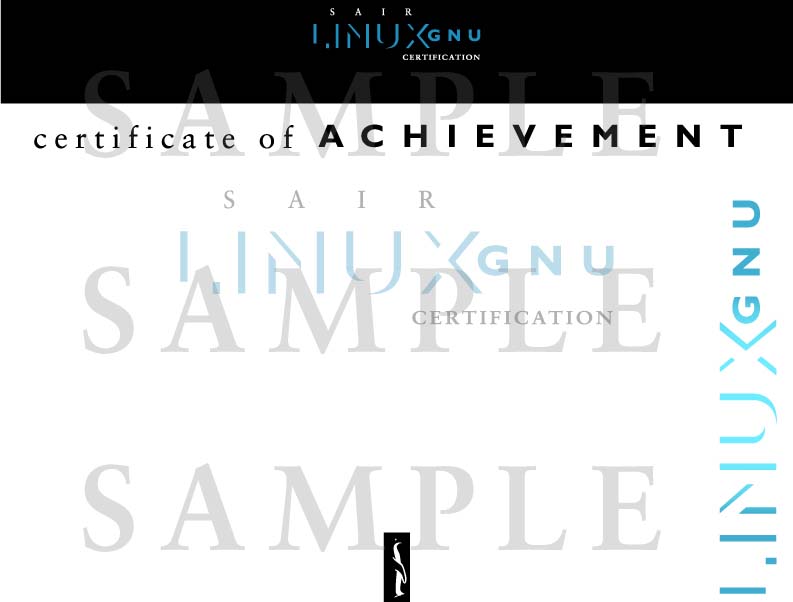
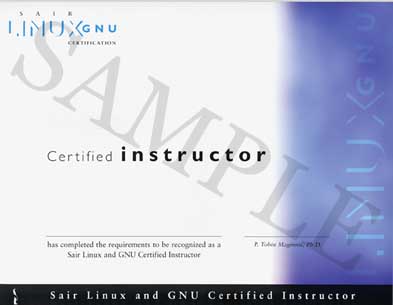
- Personal Certificate(s) of Achievement
- An 8x11 inch certificate, which is suitable for framing, will be issued for
each certificate earned.
Here are samples of the Sair Linux and GNU Certificates (click
thumbnails to view larger samples):
- A wallet ID card will also be issued for each certificate earned.
Here are samples of the Sair Linux and GNU Wallet ID
Cards:
- Access to technical forums where issues can be discussed with one's peers,
as well as the ability to participate in providing comments and insight into the
required standards established for each certificate level.
- Use of the Sair Linux and GNU logos.
Corporate and Organizational Benefits
- Reduces total cost of ownership, therefore improving employee productivity.
- Gives the company a measurement of the employee understanding of the Linux
system.
- Studies show certification reduces employee turnover.
- Company now has a standard for hiring, promoting and career planning.
|
|